Wednesday, May 16, 2012

Fish For the Future


Lately, the UW Sea Grant has been helping to generate a buzz about aquaponics, a method in which vegetables and fish are grown together in one system. The technique is also finding a place in architecture and design. Conceptual Devices has devised an bamboo aquaponics dome, hoping to make this method of food production an attractive, affordable addition to apartment rooftops. According to an article by Good, the system can feed 16 people for a year. While not for sale yet, Conceptual Devices is currently fundraising with the hopes of making mass production a reality soon.
Looking for more information? Check out UW Sea Grant's new aquaponics brochure to learn more, and don't forget to swing by their Flickr page for images of an aquaponics display at this year's Science Expeditions.

Image via Conceptual Devices

Monday, May 14, 2012

Playground design teaches students about water

Sixth graders at one New York middle school are learning about water in a unique way- by designing a new playground for their school. In addition to usual playground equipment, these young designers are also thinking about how they can clean up local waterways. The playground thus includes a butterfly garden and turf field, both designed to capture precipitation.

P.S. 242/Future Leaders Institute Community Playground

The students themselves, each given a design notebook, are highly included in the process and learning about water science in their classes. The project is jointly supported by the Trust For Public Land and the City of New York.

Interested in learning more?
Image via Trust for Public Land

Friday, May 11, 2012

Careers in Water

Deciding on a career or career move? According to a new article in the Chicago Tribune, job seekers might want to "consider diving into the water business," as many in the water and wastewater profession are nearing retirement. 

If you're interested in one of the many water-related professions, check out these resources to learn more:
Finally, check out the jobs portion of our water research guide for professional organizations, internships, career services, and more!

Wednesday, May 9, 2012

News From Wisconsin's Water Library

The latest edition of the Wisconsin's Water Library newsletter is now available! Click here to access online, or check it out via the new link on our website.

Highlights include our new books list, information about our story hours and recent events, tips for accessing water resources, and more. Interested in receiving bimonthly alerts about our newsletter? Drop us a line at Ask Water and let us know!

Monday, May 7, 2012

Take your water to go!

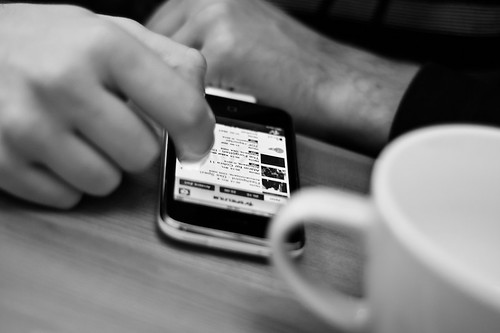
You might love Angry Birds and Words with Friends, but have you considered apps designed to help the environment? These iPhone and Android apps can help you learn about water issues no matter where you are.
smartphone era
  • Monterey Bay Aquarium's Seafood Watch app (iPhone and Android) provides up-to-date information about sustainable seafood choices in different areas of the country. It will also recommend restaurants and markets that offer sustainable seafood. Don't have a smartphone? You can access their web version here. 
  • Do you drink enough water? Drinking Water (Android) lets you track your water drinking habits.
  • What the Fish! (iPhone) is a freshwater fish identification application, filled with images and descriptions. 
  •  Creek Watch (iPhone) uses EPA data to help users monitor their watershed.
Looking for more?
Image via Steefafa (Flickr)

Friday, May 4, 2012

New safety measures for hydraulic fracturing

This week, new regulations were issued aiming to make hydraulic fracturing safer. According to a New York Times article, the law intends to "require disclosure of the chemicals used in the process" However, the new law pushes this disclosure to after drilling is completed, not before, as had originally been the case.

In addition to changing disclosure requirements, the law also addresses issues related to contamination of groundwater, and includes guidelines for well construction and wastewater treatment

Interior secretary Ken Salazar stated “As we continue to offer millions of acres of America’s public lands for oil and gas development, it is critical that the public have full confidence that the right safety and environmental protections are in place. The proposed rule will modernize our management of well stimulation activities — including hydraulic fracturing — to make sure that fracturing operations conducted on public and Indian lands follow common-sense industry best practices.”

Click here for further information from the Department of the Interior.

Wednesday, May 2, 2012

Purifying Murky Drinking Water

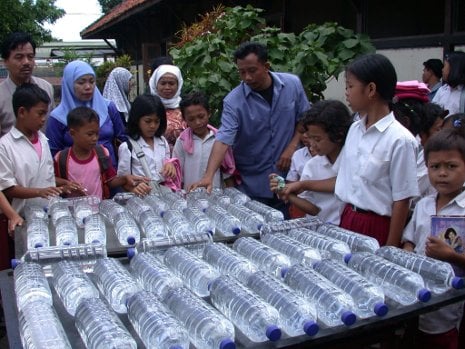
Safe drinking water is difficult to obtain in many areas of the world. Different kinds of water require different purification techniques. For example, clear water is fairly easily purified using a method called SODIS (pictured below), while murky water, which is all that many individuals in developing countries have access to, remains difficult to treat. However, a scientist at Michigan Technological University has found a way to purify muddy water.


Joshua Pearce discovered that sodium chloride causes flocculation- the process through which clay settles out of water. While adding salt to water might seem counterproductive, according to Pearce, "the water has a lower sodium concentration than Gatorade" and is still safe to drink. Once the water is no longer murky, it can be easily purified using the SODIS treatment, which relies on radiation from the sun. Next, Pearce is running tests on different kinds of clay and soil to see where else this process might be useful.

Click here to read Michigan Tech's press release about the findings, and here to access Pearce's paper, "Optimizing the Solar Water Disinfection (SODIS) Method by Decreasing Turbidity with NaCL."

Image via Michigan Tech News