Showing posts with label education. Show all posts

Friday, March 1, 2013

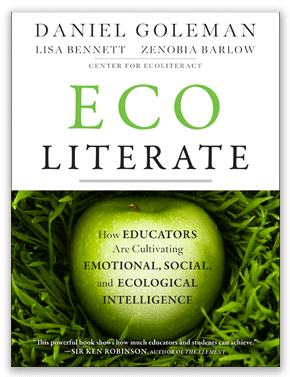
Book Review: Eco Literate


Educators, environmentalists, activists, and students will be interested in this recent addition to our library's collection, Eco Literate: How Educators Are Cultivating Emotional, Social, and Ecological Intelligence.  Readers are told how education can engage students to develop knowledge of living systems, through stories, and by using lesson plans and professional development guides. The book includes in-depth discussions  that outline stories from the field including: Standing Strong on Coal Mountain, From Anger To Action In Oil Country, Shared Water: Moving Beyond Boundaries, and Nourishing Communities With Food.  
"Eco Literate provides a veritable how-to guide for educators to creatively engage young people in the most important ecological issues of the day, helping them gain knowledge of and empathy for all living systems, which is bound to enrich their lives and protect the future of our planet."
(Gail Connelly, Executive Director, National Association of Elementary School Principals)
Goleman, Daniel, Lisa Bennett, and Zenobia Barlow. Eco Literate : How Educators Are Cultivating Emotional, Social, and Ecological Intelligence. San Francisco: Jossey-Bass, 2012.

View Center for Ecoliteracy's Eco Literate Web Page
You Tube Clip - Dan Goleman speaks about the book Eco Literate (2:18)

If you are a Wisconsin resident and would like to check out this or any other book, please fill out our book request form. If you are a UW student, faculty or staff, please request books through the Library Catalog. 

Friday, June 22, 2012

Researching chemicals

One of the fun things the Water Library gets to do is participate in outreach and today was a great treat. The UW Madison offers the PEOPLE program - the Pre-College Enrichment Opportunity Program for Learning Excellence and young women enrolled in the program and interested in STEM fields visited Steenbock Library to learn how to use library resources to research a chemical. A recent contamination event of the chemical tetrachloroethylene near Madison presented the young researchers with the opportunity of learn about hazardous chemicals, accidental spills and how researchers find information that credible, accurate, relevant to help make decision on how to proceed. Here are some of the tools the students used:

Wednesday, June 6, 2012

New Drinking Water Teaching Tools

A collaboration between the U.S. Environmental Protection Agency and the U.S. Dept. of Agriculture has produced new instructional materials to assist teachers who seek to enhance the consciousness of their high school students about where their drinking water comes from, and how sources of drinking water can be protected.

Their press release continues, "The curriculum's “hands-on” learning activities, which are related to topics such as water characteristics and contaminants, water regulations, drainage, and reducing the flow of nutrients into groundwater and surface water, will enliven the educational experience for students and teachers."

This FFA curriculum development project, funded by EPA and USDA, included a large team of drinking water experts from EPA and USDA as well an instructional design team that included FFA staff, Elaine Andrews and Kate Reilly, UW Environmental Resource Center, and Dolly Ledin and Sarah Wright, UW Institute for Biology Education.

To learn more about these teaching tools, visit their website.

Monday, May 14, 2012

Playground design teaches students about water

Sixth graders at one New York middle school are learning about water in a unique way- by designing a new playground for their school. In addition to usual playground equipment, these young designers are also thinking about how they can clean up local waterways. The playground thus includes a butterfly garden and turf field, both designed to capture precipitation.

P.S. 242/Future Leaders Institute Community Playground

The students themselves, each given a design notebook, are highly included in the process and learning about water science in their classes. The project is jointly supported by the Trust For Public Land and the City of New York.

Interested in learning more?
Image via Trust for Public Land

Tuesday, April 17, 2012

National Environmental Education Week

Fittingly, we follow National Library Week with National Environmental Education Week! This year's theme is Greening STEM (Science, Technology, Engineering, and Mathematics): The Environment as Inspiration for 21st Century Learning. It's a great way to learn about STEM education and gear up for Earth Day, too!

You can get involved by visiting the National Environmental Education Foundation website,
where you can access STEM planning toolkits, including one about water! Visit the Water Library as well; our curriculum development and kids collections include planning materials and more for water and environmental science educators.

Monday, December 5, 2011

Science Sites for Kids!

Educators are looking for ways to make STEM (Science, Technology, Engineering, and Mathematics) education more interesting and appealing to students. Many students lose interest in these subjects as they grow older- a problem that could become crucial in future generations.

Check out the websites below to help promote STEM education to the students in your life:

Sid the Science Kid
Sid the Science Kid uses comedy to promote technology and science education for preschoolers. Check out show clips online- including fun interviews with robotics engineers, astronauts, and chemists. Kids learn the role science plays in their everyday lives, like how can openers were developed by engineers, how planes fly, and more.

NASA Space Place
NASA Space Place is a kid-friendly site that provides activities and projects- helping kids learn that science, technology, and space education can be fun.

Energy Quest
Energy Quest is a fun, interactive site, from the California Energy Commission, aiming to educate kids about sustainability and conservation.

Great Science for Girls
Great Science for Girls is a five year initiative from the National Science Foundation to broaden and sustain girls' interest in STEM. GSG will reach out to afterschool centers, providing resources like curriculum development, a website, and technical assistance.

For further information, visit the National Science Foundation's Resources for STEM Education.


Thursday, April 14, 2011

Earth Day: History and Action

Earth Day evolved from a national teach-in on the environment in 1970, an idea from Wisconsin's own senator, Gaylord Nelson. He felt that attention to environmental issues was fundamental to the healthy survival of our planet and that teaching and spreading awareness would inspire action and political support. Nelson was correct and Earth Day now spans over 150 countries and was April 22 was designated International Mother Earth Day by the United Nations in 2009. UW-Madison is home to The Nelson Institute for Environmental Studies which holds an annual Earth Day Conference. This video collages participants' thoughts from last year's conference.


This year Wisconsin's Water Library is proud to be collaborating with The Rosemary Garfoot Public Library (RGPL) in Cross Plains, Wisconsin's first green library, to put on a special Earth Day storyhour presentation. RGPL does have a special environmental collection that you can read about here, and these books do circulate to Madison Public libraries as well. See the Water Library's reading list on environmental activism books for kids. There is also a wealth of additional information about Earth Day at this website.

Video credit: Nelson Institute at UW-Madison

Thursday, February 3, 2011

Great Lakes Literacy Principles

Awarded "Site of the Month" by Great Lakes Information Net-work (GLIN), Great Lakes Literacy Principles, prepared by the Ohio Sea Grant College Program, is a website that explains "essential principles and fundamental concepts for Great Lakes learning" and further matches those concepts with Ocean Literacy ones. It breaks down eight specific concepts about the Great Lakes and helps to explain the importance of peoples' interactions with the lakes.

The eight areas which are broken down range from what are the Great Lakes and how were they formed, to the influence of climate and weather on the lakes, to the types of species that inhabit the lakes, to connections between the lakes and what can be learned from the Great Lakes. The site also has a handy pdf brochure that explains the concept of Great Lakes Literacy and the eight areas from the website. This site is endorsed by the National Science Foundation (NSF), the National Oceanic and Atmospheric Administration (NOAA), and Sea Grant and can be a helpful resource for teaching or learning about the Great Lakes.

Image from greatlakesliteracy.net/

Wednesday, January 12, 2011

New Wisconsin Climate Change Resource

Recently, a new multimedia resource, Climate Wisconsin, was put together by the Educational Communications Board (ECB). This interactive website features stories about the rapidly changing climate. The collection of multimedia includes ten videos and two interactive resources along with background essays and teaching tips. Educators can also access the Teachers' Domain where stories can be streamed or downloaded. The goal of this project is make these materials available in a variety of formats in order to support teaching and learning about climate change in Wisconsin.

Much of the content on the site, including background essays and teaching tips, was developed in collaboration with the Nelson Institute for Environmental Studies and Center for Biology Education at UW-Madison. Additional research contributions were made by the Wisconsin Initiative on Climate Change Impacts (WICCI).

Screenshot of Birkebeiner video from Climate Wisconsin.

Wednesday, December 1, 2010

"Climate Change Adaptation Tools for Addressing Water Issues"

EPA's Watershed Academy has sponsored over 50 free webcast seminars with the intent of educating people on water-related issues. The webinars are free and open to anyone, all you need to do is sign up. For those people who are unable to attend the webinar, a streaming audio version of the training is made available on the EPA's website.

This week's webinar on Thursday, December 2nd, from 12-2pm CST, will be "Climate Change Adaptation Tools for Addressing Water Issues." It will discuss some of EPA's plans for community adaption to climate change, a program to assess climate change vulnerabilities, and case studies addressing climate change impacts. To read a more detailed summary of the webinar, visit the Watershed Academy Seminar page.

To sign up for this week's webinar, click here. For reading lists of climate change materials related to water, divided by subject, visit our library's page. A reading list with climate change materials for children can be found on our site as well.

Photo from EPA Watershed Academy website.

Friday, November 19, 2010

Great Lakes Earth Partnership

Earth Partnership for Schools (EPS), a statewide initiative, is growing. Founded in 1991, the program is meant to connect people with the land and water where they live. One of the program's goals is to allow children to experience nature while at school. Ecological restoration is another main focus. EPS helps young ones to understand their connection to the land and how they can help to give back.

Phase I of the Great Lakes Earth Partnership, a new regional EPS initiative funded by Wisconsin Sea Grant, recently took place in waters across the state including the Milwaukee River, estuaries of Lake Superior, the Kakagon Wild Rice Sloughs and others. Findings of the different teams will be discussed in Green Bay this winter. Read more about phase I in the Arboretum News Release.

Phase II is scheduled to continue in 2011 with funding from the EPA Great Lakes Restoration Initiative.

Photo courtesy of UW Arboretum.

Wednesday, September 22, 2010

Project WET - Water Education for Teachers

Project WET, a national program that is delivered on a statewide basis, is available for teachers interested in becoming qualified to teach water education. They provide materials that can be used to get kids thinking about water and environmental issues. Materials from this non-profit water education program are available for kids ages 5-18. The prepared teaching materials are "designed to facilitate and promote awareness, appreciation, knowledge, and stewardship of water resources" (DNR release).

Incorporating different learning styles, including community service opportunities, there are over 90 activities available from Project WET. There are four main beliefs upon which Project WET was founded. One, water quantity and quality is important to all users. Two, knowledgeable water management is key to maintaining a healthy environment. Three, water connects a vast array of life and systems. Finally, being aware and respectful of water resources can encourage positive community involvement. Teachers are also able to sign up for workshops that are conducted by a network of Wisconsin facilitators.

For further curriculum ideas involving water, see our website.

Picture of Project WET booklet courtesy of WDNR.

Thursday, January 14, 2010

EEK!

What a great name for a Web site... The Wisconsin Department of Natural Resources has great resources and activities here for kids and teachers. The EEK! (Environmental Education for Kids) Web site (link) is geared toward schoolchildren in grades 4 though 8 and their teachers.

Some highlights you shouldn't miss:

Water Wonders has lots of activities to learn about the wet world we live in.

The amphibians section for kids has a whole lot of great information on frogs and toads (a favorite of Water Library patrons).

Find out what critters stay "snug in the snow" in our cold state...

The Teacher's Pages are chock-full of resources on a wide range of topics. And don't miss the new Climate Change Guide from DNR for grades 7 through 12.

If you have any questions, don't hesitate to askwater at aqua.wisc.edu

Wednesday, September 2, 2009

Teacher training opportunities

Educator Workshop and Events from the Wisconsin Department of Natural Resources are now listed online on the EEK Web site. There are events on climate chance, water, critters, and more.

Friday, July 24, 2009

On the Lake Guardian with COSEE Great Lakes

The Center for Ocean Sciences Education Excellence (COSEE) Great Lakes invites 4th-10th grade teachers and non-formal educators to participate in one of two week-long Shipboard and Shoreline Science workshops aboard the U. S. Environmental Protection Agency’s 180-foot research vessel (R/V) Lake Guardian every year. Educators work beside scientists, participating in Great Lakes research and stopping in ports for additional science experiences. In addition to shipboard and shoreline science, participants will examine curricula and resources and explore classroom activities relating to the Great Lakes and oceans.

In July of 2009, a group of 15 teachers spent seven days with a team of Great Lakes scientists aboard the EPA's research vessel the Lake Guardian living the life of a researcher on Lake Superior. One of the teachers made a video documenting many parts of the expedition. To view this video, click here.